
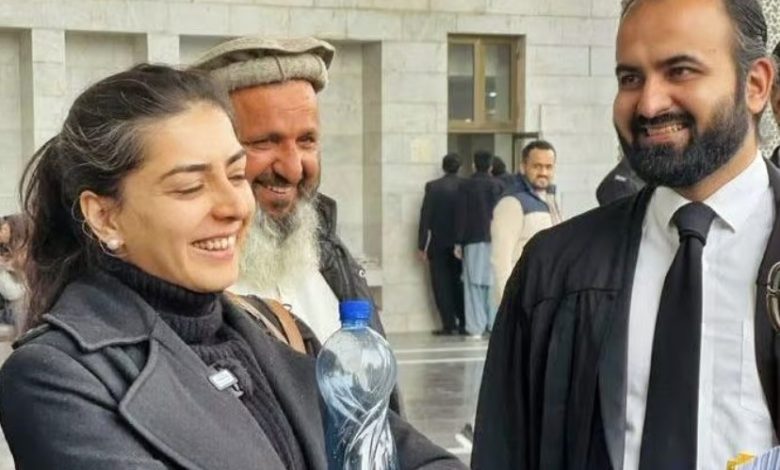
ISLAMABAD – Pakistani court handed 17-year prison sentence to dissent activist and lawyer Imaan Mazari and her husband Hadi Ali Chatha over series of controversial tweets.
The couple, who had already faced judicial custody in another case, boycotted the hearing, claiming mistreatment and a lack of basic necessities.
District and Sessions Courts in Islamabad announced the verdict against Mazari and her husband, announcing rigorous 17 years in prison each in a high-profile case involving controversial tweets.
Earlier, Islamabad High Court directed duo to complete cross-examination of witnesses by this date. Despite these orders, the couple refused to participate, citing alleged mistreatment in custody, including being denied food and water.
The court also imposed total fine of Rs 36 million. Breaking down the sentence, under Section 9 of the Prevention of Electronic Crimes Act (PECA), each received five years in prison and a Rs 50 lakh fine. Under Section 10, they were sentenced to 10 years and fined Rs 30 million, while Section 26A carried an additional two-year sentence with a Rs 10 lakh fine.
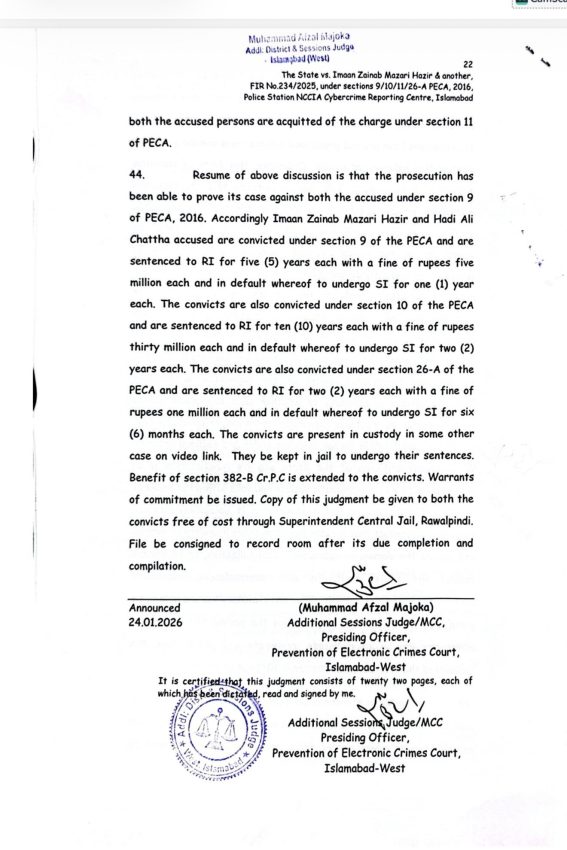
Due to judicial custody in a separate case, Imaan and Hadi appeared via video link. The prosecution, represented by Barristers Fahad, Usman Rana, and Mansoor Azam, presented five witnesses and a challan exceeding 30 pages, claiming the couple spread the agenda of PTM and other banned organizations and shared material critical of state institutions. The court was also shown tweets and anti-state speeches made by Imaan Mazari as evidence.
Earlier, proceedings were disrupted when the couple walked out after the court reserved its order. Imaan questioned the presence of media in the courtroom and directly addressed the judge, saying, “You are doing your job … everything is happening because of you,” before announcing the boycott alongside her husband.
The presiding judge instructed court staff to record the entire proceedings and include them in the judicial record. Defence counsel Ashraf Gujjar requested the summoning of a relevant individual, but the judge noted the person had already appeared online and reserved judgment on the matter.