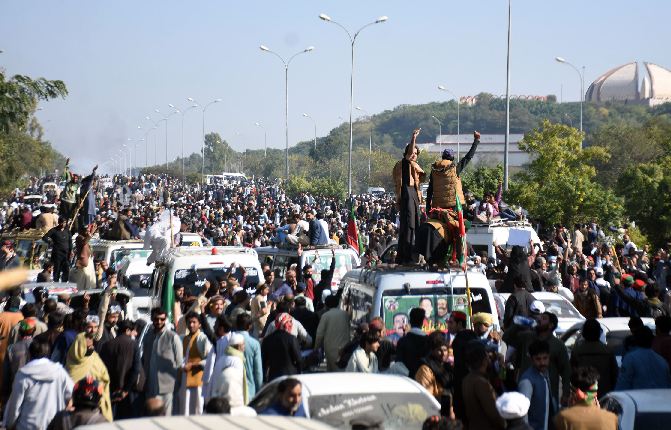
ISLAMABAD: The Islamabad High Court (IHC) on Monday directed chief ministers to ensure provincial state machinery is not used for protests, while disposing of a petition against the Pakistan Tehreek-e-Insaf’s (PTI) planned long march towards Islamabad on September 27.
A three-member bench headed by IHC Justice Sardar Muhammad Sarfraz Dogar heard arguments from the parties, including the Islamabad attorney general and the petitioner’s counsel.
In its verdict, the court directed the chief ministers to ensure that government vehicles, machinery, funds and other equipment are not used for marches, processions or rallies.
It further ordered that no government employee should be forced to participate in a protest, while directing provincial governments, the Islamabad administration and relevant authorities to ensure citizens’ constitutional rights were protected during marches, rallies and demonstrations.
The court ruled that no political party or leader had a legal right to occupy roads, highways or other public places.
It also said political parties or leaders could not obstruct citizens’ freedom of movement, directing the Islamabad administration and interior ministry to ensure protection of citizens’ constitutional rights.
The IHC also issued directions to the federal secretary interior, chief commissioner, and inspector general of Islamabad.
The PTI has announced nationwide protests and a long march towards the federal capital on September 27 to demand the release of jailed party founder Imran Khan.
During today’s proceedings, the Islamabad AG argued that the PTI brought government machinery during previous long marches and claimed there was no indication that its proposed march would remain peaceful.
“They say our long march will be very peaceful and that they are coming to strengthen the judiciary,” the attorney general said.
He also referred to a statement saying, “either freedom or martyrdom”, and sought permission to play videos from PTI’s November 2024 protest before the court.
The IHC chief justice initially observed that playing videos in the courtroom was not a judicial practice; however, Justice Dogar subsequently allowed the videos to be shown.
Footage of PTI protests
Videos showing Islamabad police preparations, alleged shelling on police personnel, removal of containers, fires at D-Chowk and the Green Belt, damage to public property and images of martyred police personnel were played in court.
A video showing Rangers personnel being run over by a vehicle was also played.
“By any means, this is not a scene of a peaceful gathering,” the attorney general said, adding that Islamabad had been “completely destroyed” by setting fires.
He argued that citizens have fundamental rights, but said those rights are subject to conditions where peace and national security are concerned.
The attorney general said anyone seeking to hold a protest or organise a long march in Islamabad would have to apply to the magistrate and provide details of the march.
He said the district magistrate could reject an application if not satisfied about security arrangements.
He also maintained that placing containers in Islamabad was lawful and that the federal government could declare any area of the capital a Red Zone.
The attorney general said the government was not against any political party or leader, but stressed that protests should be conducted according to law.
He claimed that the PTI had not submitted an application to the magistrate seeking permission for the proposed protest.
‘PTI demands unlawful’
The attorney general also said PTI’s demands included the release of jailed party founder and the removal of the government, describing both demands as unlawful.
“The method of getting a convicted prisoner released is through the courts,” he added.
During the hearing, Chief Justice Dogar questioned whether government representatives also had the right to provoke citizens through their statements.
“Can chief ministers or government representatives make such speeches?” the IHC chief justice asked.
The attorney general replied that no one had such a right, saying provoking citizens did not fall within freedom of expression.
After the attorney general completed his arguments, the petitioner’s counsel questioned whether authorities should wait until damage occurred, citing statements that up to four million people could enter Islamabad.
He also raised concerns about the impact of the proposed protest on residents of the federal capital, saying PTI leaders were repeatedly stating that they were coming to Islamabad.
The petitioner’s counsel further argued that the personal conduct of the Khyber Pakhtunkhwa Chief Minister Sohail Afridi was affecting his official duties.
Following the conclusion of arguments, Justice Dogar reserved a decision on the petition, directing all parties to wait for the verdict.