
RAWALPINDI – New Delhi’s latest ‘slain militant’ narrative turns out to be a joke as an unidentified man killed in occupied Kashmir got a name, a militant alias, an elite commando past and even an alleged connection to the Pahalgam attack.
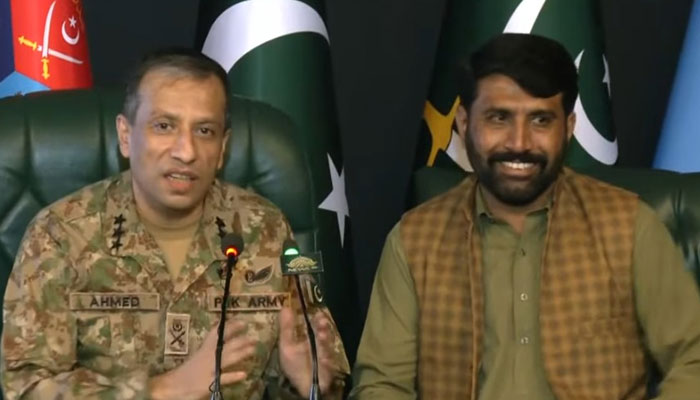
The man identified by Indian media as Muhammad Asif alias Hashim Moosa appeared alive at a press conference alongside DG ISPR Lt Gen Ahmed Sharif Chaudhry. Indian authorities and media reported that a Pakistan-based Lashkar-e-Taiba (LeT) militant, allegedly wanted in connection with the April 22 Pahalgam attack, had been killed during an operation in the Korag-Yousmarg area of occupied Kashmir.
Dead man walking?
DG ISPR Lt Gen Ahmed Sharif Chaudhry described the episode as a “so-called terrorist incident”, alleging that it was part of a false-flag operation by India’s political and military establishment. He presented a five-point chronology, beginning with the Indian Army’s announcement of the Korag operation on September 29.
DG ISPR invited Muhammad Asif to join him. Asif said he was from Attock district and described how friends had contacted him after seeing social media reports claiming that he had been killed by the Indian Army in Kashmir. He said he told them he was “alive and healthy.”
Asif further claimed that he received calls from Indian numbers seeking his personal information, identity, whereabouts and alleged connection to the reports.
He said he subsequently became aware through ANI’s social media posts that Indian media had used his personal information while reporting that he had been killed during an operation in Kashmir.
According to Indian version, troops detected suspicious movement, challenged suspected militants and came under fire, triggering an exchange in which one alleged terrorist was killed. The Indian Army subsequently said the body recovered during a search was that of Muhammad Asif alias Hashim Moosa. The identity, however, became the centre of the dispute.
The initial Indian announcement did not publicly identify the person reported killed. The narrative subsequently expanded to name him as Muhammad Asif alias Hashim Moosa, with Indian authorities describing him as a Pakistan-based LeT operative.
Indian media then went further, portraying him as a former Pakistani Army serviceman who had allegedly served with the elite Special Services Group (SSG). Indian reporting described him as a Havildar and attributed an extensive military history to him.
Indian reports attributed to unnamed sources claimed that Asif was born on March 7, 1980, joined the Pakistan Army in 2000 and served under service number PA-3106947. The reports claimed that he retired as a Havildar before allegedly joining the SSG in 2005.
According to the reported profile, he served with the 4 Commando “Yalgar” Battalion and was allegedly deployed to Balochistan from 2006. Indian reports further claimed that he participated in approximately 10 operations against Baloch insurgents and was credited with 13 personal kills.
Another claim attributed to Indian sources was that he had served on the security detail of former president Pervez Musharraf. The allegations were subsequently incorporated into a wider Indian narrative portraying the alleged slain man as a former Pakistani commando who later became an LeT operative.
The alleged military background was followed by another major claim: that Asif was wanted in connection with the Pahalgam attack. Indian media described him as a key figure in the militant network allegedly behind the attack, while the Indian Army linked the reported killing to its wider operations against militants in Kashmir.
Pakistan has rejected Indian allegations concerning Pakistani involvement in the Pahalgam attack.
During his briefing, the DG ISPR also read out Indian claims linking Asif to multiple attacks. The incidents cited included the Kandi attack in May 2023, Halan attack in August 2023, DKG attack in December 2023, Shah Sitar attack in May 2024, Shiv Khori attack in June 2024, Gagangeer attack in October 2024, Boota Pahari attack in October 2024 and Basira attack in April 2025.
Lt Gen Chaudhry said the narrative was subsequently repeated through India’s Ministry of Home Affairs and Press Information Bureau, moving the claims beyond media reports and into official communications.
India’s Home Ministry reportedly described the killing of “Musa alias Asif Fauji” as part of an ongoing operation that it said had been underway for months. DG ISPR responded with biting sarcasm, saying: “After six months of hard work, Musa alias Asif Fauji has been neutralised. Congratulations, applause.”
He also displayed reports from Indian outlets including News18, The Statesman, India Today, Hindustan Times, ABP Live and The Indian Express, mocking what he portrayed as the rush to amplify the claims.